What you bring on Kilimanjaro affects your summit chances. Gear that is too light leaves you dangerously cold on summit night; gear that is too heavy slows you down and exhausts your porters unnecessarily. This packing list is based on what our guides recommend — and have seen fail — on thousands of climbs since 2012.
Your porter carries up to 15 kg of shared equipment (tent, food, camp gear). You carry a day pack of 5–8 kg containing everything you need access to on the trail. Everything else goes in your duffel bag with the porters.
The Non-Negotiables
These items are essential for safety and summit success. Arrival without them is a serious problem.
Footwear
- Waterproof hiking boots — ankle-high or mid-high. Must be broken in (minimum 3 full hiking days before the climb). New boots are the most common preventable problem we see. Lace them with enough space to accommodate swollen feet at altitude.
- Gaiters — waterproof, covering ankle to mid-calf. Protects from mud in forest zones and scree on descent.
- Camp sandals or lightweight shoes — for wearing at camp. Your hiking boots will be wet and cold by day 2.
- Hiking socks — 3–4 pairs of merino wool or synthetic. Avoid cotton entirely. Liner socks inside hiking socks reduce blister risk significantly.
Clothing — Layering System
Temperature on Kilimanjaro ranges from 25C at the rainforest base to -20C on summit night. The layering system is the only way to manage this range.
- Base layer (2) — moisture-wicking long-sleeved top and leggings. Synthetic or merino. Avoid cotton — it stays wet and causes hypothermia.
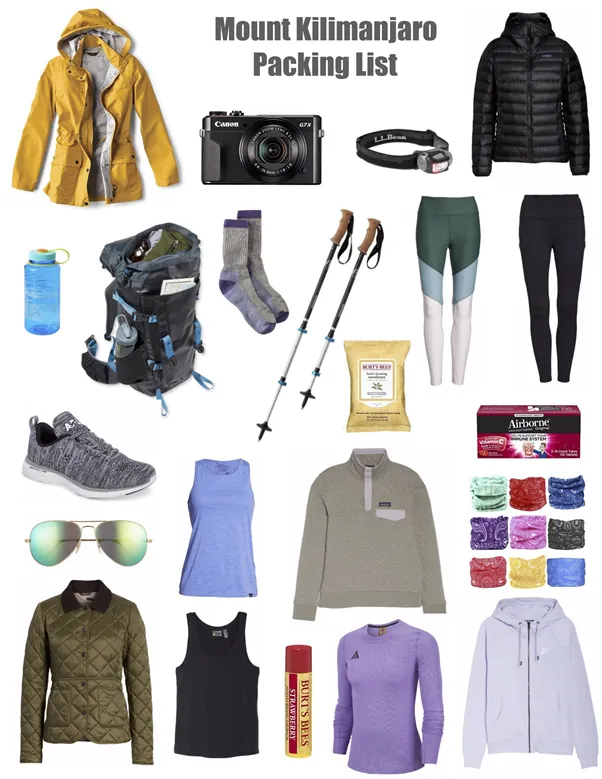
- Mid-layer (1–2) — fleece jacket and/or down jacket rated to at least -10C. The down jacket is what keeps you alive on summit night. Do not under-invest here.
- Outer shell — waterproof jacket — fully waterproof and windproof (not just "water resistant"). Essential for the forest zone and for summit night wind. Bring both jacket and waterproof trousers.
- Softshell trousers — for hiking days. Not waterproof but breathable and warm.
- Warm hat — wool or fleece, covering ears. Brings one for sleeping and one for hiking.
- Balaclava — for summit night when temperature and wind combine.
- Gloves — bring two pairs: a thin liner glove for hiking days and a thick waterproof outer glove rated to -20C for summit night.
- Gaiters — already mentioned but worth repeating: essential for the scree and mud.
- Neck gaiter or buff — versatile for sun, cold, and dust.
- Short-sleeved shirts (2) — for warm lower sections (forest zone, days 1–2).
Sleeping
- Sleeping bag — rated to -15C or colder (comfort rating, not limit rating). This is the most commonly under-specified item. Rental is available in Moshi if you cannot bring one — ask us to arrange it.
- Sleeping bag liner — adds 5–10C of effective warmth and keeps your sleeping bag cleaner.
Trekking Equipment
- Trekking poles — strongly recommended. They reduce knee impact by 25–30% on descents. Collapsible for packing. Carbon or aluminium — aluminium is more robust for rocky terrain.
- Headlamp — summit night begins in darkness. Bring spare batteries and do not rely on your phone torch. Lithium batteries perform better in cold.
- Day pack — 20–30L, with hip belt to distribute load. Must fit all the items you carry on the trail. Rain cover included or purchased separately.
- Duffel bag — 70–90L for your porter bag. Must have a top-opening design (not a rucksack) for porter carry. A padlock for the zips is useful.
- Water bottles or hydration bladder — minimum 2–3L capacity. Hydration bladder tubes freeze on summit night — use hard-sided bottles and carry them inside your jacket close to your body.
- Water purification tablets or filter — as backup. We provide boiled and treated water at camp but purification tablets add a safety margin.
Health and Safety Items
- Sunscreen — SPF 50+. UV radiation increases significantly with altitude. Apply every 2 hours above 3,000m.
- Lip balm with SPF — lips are particularly vulnerable to UV and cold drying.
- Sunglasses — wraparound UV400 protection. Snow blindness is possible in open alpine zones.
- Personal first aid kit — blister treatment (moleskin, second skin), ibuprofen, paracetamol, antihistamine, diarrhoea medication (immodium), antiseptic wipes, and any personal prescriptions. Your guide carries a group kit but personal items matter.
- Diamox (acetazolamide) — if your doctor has prescribed it. See our altitude sickness guide for full details.
- Hand sanitiser — toilet facilities at camps range from basic to non-existent above Horombo. Sanitiser is essential between camps.
- Wet wipes — for cleaning up when shower facilities are unavailable (days 2–6 on most routes).
- Toilet paper — bring your own. Bring a small bag for used paper (leave no trace).
Nutrition and Hydration
We provide three cooked meals and hot drinks daily. However, having additional high-energy snacks available on the trail makes a meaningful difference, especially on summit night when appetite is suppressed by altitude.
- Energy bars and gels — 2–3 per day. Choose high-carbohydrate, easy to eat while walking.
- Nuts, dried fruit, and chocolate — 500g–1kg for the full climb. Calorie-dense and palatable at altitude.
- Electrolyte tablets or powder — add to water bottles. Altitude causes increased urination; electrolytes replace what you lose.
- Ginger sweets or tablets — effective for mild nausea at altitude. Not a cure, but useful.
Hygiene and Comfort
- Biodegradable soap and shampoo — for the camp shower option on Marangu (other routes have no shower facilities)
- Toothbrush, toothpaste, and dental floss
- Small towel — microfibre dries quickly
- Earplugs — camp sleeping can be disrupted by other groups and wind
- Eye mask — optional but helpful for the daylight sleeping hours before midnight summit push
Electronics
- Camera — phone camera is adequate but a dedicated camera with image stabilisation performs better at altitude. Bring a spare battery: cold depletes batteries fast.
- Power bank — 10,000–20,000mAh. There is no charging on the mountain above base camp. Keep it inside your sleeping bag at night to prevent cold-induced shutdown.
- Universal power adapter — Tanzania uses Type G (British) and Type D (Indian) sockets.
- Dry bags or waterproof cases — for electronics in the forest zone where rain is common.
Documents
- Passport — required for park gate registration.
- Printed booking confirmation — helpful but not mandatory if we have the reference number.
- Travel insurance policy document — with emergency contact numbers and your policy number. Medical evacuation from Kilimanjaro requires payment before assistance; insurance is not optional.
- Emergency contact information — written on paper, not just stored in your phone.
What Not to Bring
- Jeans or cotton trousers — cotton retains moisture, dries slowly, and is dangerous when wet and cold.
- Heavy technical climbing gear — Kilimanjaro does not require crampons, harnesses, or ice axes on any standard route.
- More than 3 days of casual reading material — weight adds up. Digital reading is efficient.
- More than two changes of hiking clothes — porters have weight limits. Pack essentials, not options.
- Bulky camera equipment — a tripod for the mountain is rarely practical; it is heavy and the summit conditions make stable tripod shots difficult.
Weight Guidance
Your duffel bag (carried by a porter) should not exceed 15 kg. Your day pack should weigh 6–8 kg when full. If you are over these limits, review your gear list item by item — almost every kit has things that can be left behind.
We Send a Full Gear List on Booking
Every confirmed climber receives our detailed printable packing list specific to their route and season. We can also advise on gear rental in Moshi (sleeping bags, trekking poles, gaiters).
Book Your Kilimanjaro Climb