Altitude sickness is the single most common reason people fail to reach Kilimanjaro's summit. It affects experienced athletes and sedentary hikers in roughly equal measure — physical fitness does not protect you from altitude sickness in the way it protects you from general fatigue. Understanding what it is, how to recognise it, and what we do about it on our climbs is the most important preparation you can do before setting foot on the mountain.
What Is Altitude Sickness?
Altitude sickness — more precisely, Acute Mountain Sickness (AMS) — occurs when your body does not have enough time to adjust to reduced oxygen levels at high elevation. At Kilimanjaro's summit (5,895m), the air contains roughly 50% of the oxygen available at sea level. Most people begin to feel the effects somewhere between 2,500m and 3,500m, though this varies significantly between individuals.
AMS exists on a spectrum: mild symptoms are common and expected; severe altitude illness (High Altitude Pulmonary Oedema, or HAPE, and High Altitude Cerebral Oedema, or HACE) is a medical emergency that requires immediate descent.
Symptoms: What to Know at Each Stage
Mild AMS (Common above 3,000m)
Mild AMS is essentially expected on Kilimanjaro and does not necessarily mean you should turn back. Symptoms include:
- Headache (typically a dull pressure rather than a sharp pain)
- Fatigue and weakness beyond what the day's hiking effort would explain
- Reduced appetite and mild nausea
- Poor sleep quality and vivid or fragmented dreams
- Mild dizziness
The standard response to mild AMS is: slow down, drink more water (at least 3–4 litres per day), take ibuprofen or paracetamol for the headache, and do not ascend further until symptoms resolve. On our climbs, our guides monitor your oxygen saturation with a pulse oximeter twice daily — a reading consistently below 80% at a given altitude signals the need for closer monitoring or a rest day.
Moderate AMS (Warning Signs)
Moderate AMS means the body is not coping with the current altitude. Do not ascend further with any of these symptoms:
- Severe, persistent headache that does not respond to medication
- Persistent vomiting
- Extreme fatigue — unable to keep pace on flat ground
- Significant shortness of breath at rest
- Loss of coordination (stumbling on flat ground)
Our guides are trained to make descent calls. If you develop moderate AMS, the right decision is to descend to the previous camp and spend an additional night there. Descent is the most effective treatment for altitude sickness — even a few hundred metres of descent can produce rapid improvement.
Severe AMS — HAPE and HACE (Medical Emergency)
Severe altitude illness is rare but can develop quickly from moderate AMS. HAPE (pulmonary oedema — fluid in the lungs) and HACE (cerebral oedema — fluid in the brain) are life-threatening if not treated immediately with descent and oxygen.
Warning signs of HAPE: persistent dry cough, breathlessness that is severe at rest and does not improve with rest, coughing up pink or frothy sputum.
Warning signs of HACE: severe confusion, inability to walk in a straight line, extreme drowsiness, loss of consciousness.
If either of these develop, descent begins immediately. We carry supplemental oxygen on all summit day ascents and our lead guides have Wilderness First Responder training.
How Acclimatization Works
Acclimatization is the process by which your body adapts to reduced oxygen availability. Over several days at altitude, your breathing rate increases, your kidneys adjust blood chemistry, and your body produces more red blood cells to carry available oxygen more efficiently.
The most important principle is: ascend slowly. The body can typically acclimatize at a rate of about 300–500m of sleeping altitude gain per day above 3,000m. This is why the "climb high, sleep low" approach used on the Machame and Lemosho routes works — you gain altitude during the day (exposing your body to higher altitude), then sleep lower (giving your body a safer recovery environment).
Why Route Choice Affects Your Risk
The route you choose directly affects your acclimatization opportunity — and therefore your risk of altitude sickness. Our summit success rates reflect this:
- 9-day Northern Circuit (90–95%) — most gradual altitude gain
- 8-day Lemosho (88–93%) — extra Shira Plateau night
- 7-day Machame (85–90%) — "climb high, sleep low" acclimatization day
- 6-day Rongai (75–82%) — adequate but less optimised profile
- 6-day Marangu (70–75%) — no dedicated acclimatization day
- 6-day Umbwe (65–72%) — fastest altitude gain, highest AMS risk
If summit success is important to you, choose a route with more days. The extra cost is worth it.
What We Do on Every Climb
Our altitude management protocols on every Kilimanjaro climb:
- Pulse oximetry twice daily — blood oxygen saturation measured at breakfast and dinner and recorded. Any concerning readings are acted on.
- Slow pacing — our guides use a deliberate "pole pole" (slowly, slowly) pace. Rushing the ascent is the most common error made by trekkers who arrive fit and confident.
- Supplemental oxygen — carried on all summit day ascents for emergency use.
- Gamow bag — available for extreme emergencies. A portable hyperbaric chamber that simulates descent by increasing air pressure.
- Trained guides — our lead guides hold Wilderness First Responder certification and follow clear protocols for altitude management decisions.
- Descent authority — our guides have clear authority to recommend or mandate descent. A guide who tells you to turn back is protecting your life, not undermining your effort.
Diamox (Acetazolamide) — The Facts
Acetazolamide (brand name Diamox) is a prescription medication that speeds up acclimatization by stimulating faster breathing. Many doctors recommend it for Kilimanjaro. Here is what you need to know:
- It is not a cure for altitude sickness — it reduces the risk but does not eliminate it
- Common side effects: increased urination, tingling in fingers and toes, slight blurred vision
- Not suitable for people allergic to sulfonamide antibiotics
- Standard dosage is 125–250mg twice daily, starting 24–48 hours before ascent
- Consult your doctor before taking it — do not self-prescribe based on this guide
We do not require or recommend Diamox universally. Many of our clients summit successfully without it. It is one tool among several — not a substitute for adequate acclimatization days.
What You Can Do Before Your Climb
Physical fitness does not prevent altitude sickness, but it does reduce the physiological stress of the climb, leaving your body more capacity to manage altitude. In the 3–6 months before your climb:
- Build aerobic fitness with running, cycling, or swimming 3–4 times per week
- Do multi-day hiking trips — ideally at altitude above 2,000m if accessible
- If you have access to altitude training facilities (some urban gyms have altitude tents or rooms), they are useful but not essential
- Stay well-hydrated in the weeks before — arrive in Tanzania already well-hydrated
- Consult your doctor if you have any history of altitude sickness, heart conditions, or respiratory issues
On Summit Night: Managing Altitude at Its Worst
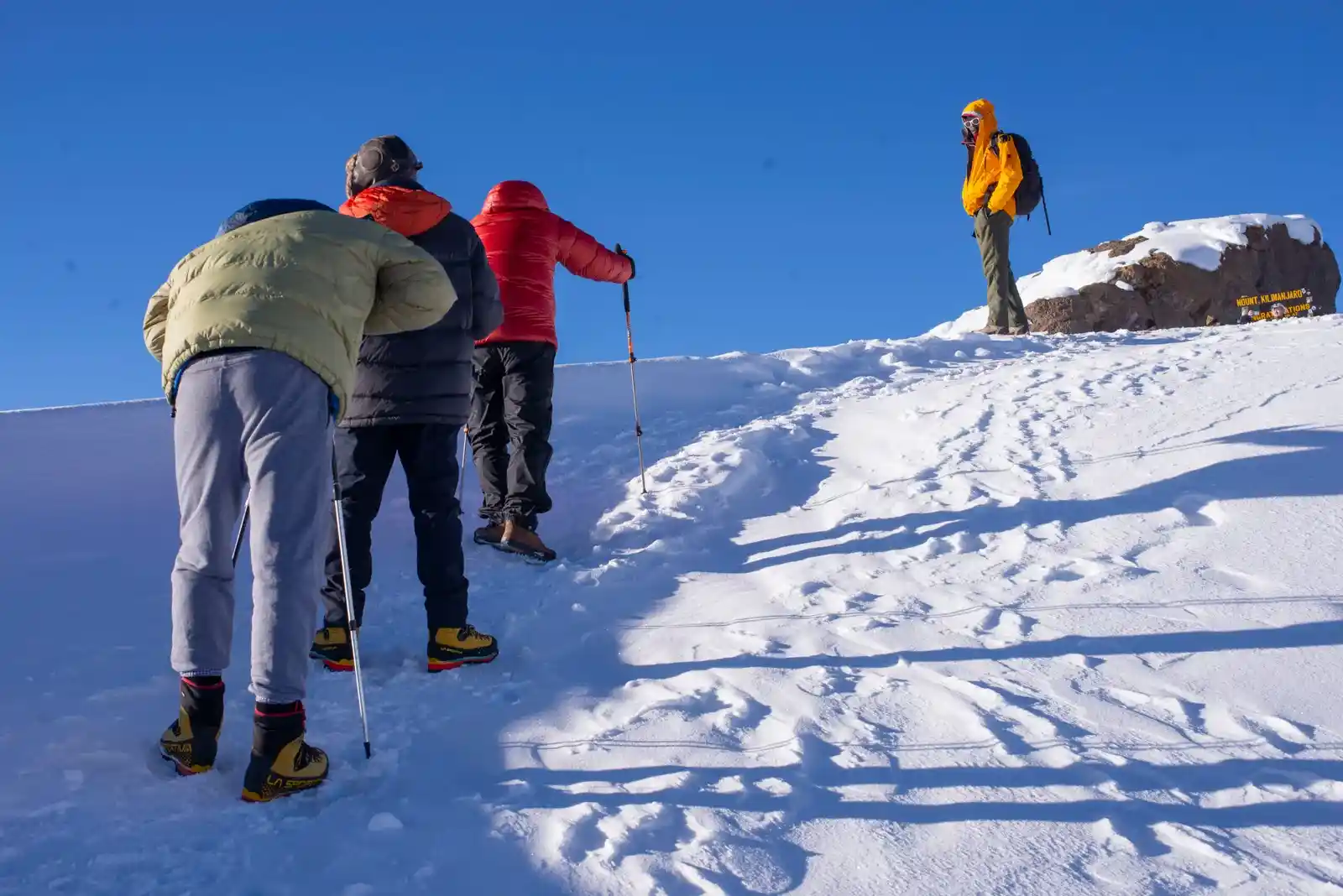
Summit night (typically beginning between midnight and 1am from Barafu Camp at 4,673m) involves ascending from 4,673m to 5,895m — a 1,222m gain in approximately 6 hours. This is the point of highest altitude stress. What to expect:
- Cold (-10 to -20C at summit in winter months) combined with thin air makes breathing feel harder than the effort warrants
- Mild symptoms — headache, fatigue, nausea — are common and manageable
- Pace matters more than fitness at this stage — your guide sets the pace
- Turning back at Stella Point (5,756m) is always an option. Stella Point is on the crater rim and carries a TANAPA summit certificate. The remaining walk to Uhuru Peak (5,895m) adds 45–60 minutes along the crater rim.
The Most Important Thing to Know
Altitude sickness is not a sign of weakness or poor preparation. Fit, experienced athletes develop it; first-time hikers do not. The mountain does not care about your fitness level — it responds to how quickly you ascend and how well your individual physiology handles reduced oxygen. Respecting the mountain means giving it enough time. Choose your route accordingly, and trust the guides who make descent calls. They are protecting your safety, not diminishing your achievement.
Ready to Plan Your Kilimanjaro Climb?
Our operations team in Moshi can advise which route best suits your fitness level, schedule, and summit goals. We respond to all inquiries within 2 hours.