What Is the Great Migration?
The Great Wildebeest Migration is not a single event — it is a continuous clockwise circuit made by 1.5 million wildebeest, 250,000 zebra, and approximately 500,000 Thomson's gazelle through the Serengeti-Masai Mara ecosystem, driven entirely by rainfall and the growth of fresh grass. The herds follow a predictable seasonal pattern, but the timing of specific events — particularly river crossings — can vary by days or weeks.
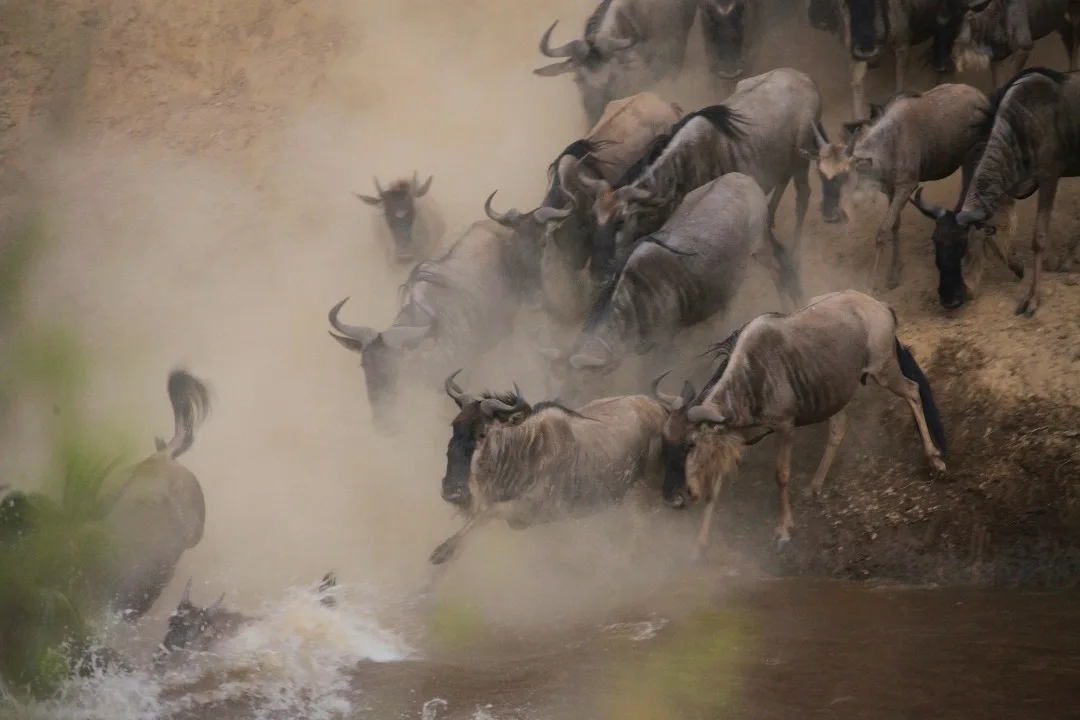
The Migration has no true beginning or end. The wildebeest are always moving. What changes is the drama: calving season in January–February produces newborn wildebeest in extraordinary numbers, attracting predator concentrations unlike any other time. The Mara River crossings in July–September involve thousands of animals plunging into crocodile-filled water simultaneously — one of the most spectacular wildlife events anywhere in Africa.
The Annual Migration Circuit
| Month | Rating | Conditions |
|---|---|---|
| December | Good | Herds in southern Serengeti short-grass plains. Scattered and grazing. |
| January | Excellent | Calving season begins. Newborn wildebeest attract lion, cheetah, hyena. |
| February | Excellent | Peak calving. Up to 8,000 calves born per day. Predator activity extraordinary. |
| March | Good | Calving ending. Herds massing. Long rains approaching. |
| April | Fair | Long rains. Herds moving northwest through central Serengeti. Wet tracks. |
| May | Fair | Northwestern Serengeti. Grumeti River crossings beginning. Wet season. |
| June | Good | Grumeti crossings. Herds approaching western corridor. |
| July | Excellent | Herds arriving in northern Serengeti. First Mara River crossings. |
| August | Excellent | Peak crossing month. Multiple crossings possible per day at busy sites. |
| September | Excellent | Crossings continuing into Masai Mara (Kenya) and back. High-quality game viewing. |
| October | Good | Herds moving south again. Transition period. Fewer crossings. |
| November | Fair | Short rains. Herds dispersing in southern Serengeti. Short-grass growth. |
Calving Season: January–February
The calving season is among the most dramatic wildlife events in the Serengeti, yet it receives less international attention than the river crossings. Approximately 500,000 wildebeest calves are born in a 3-week window — an evolutionary strategy called synchronised calving that overwhelms predators through sheer numbers. Cheetah, lion, spotted hyena, wild dog, and jackal all converge on the short-grass plains of the southern Serengeti and Ndutu area during this period.
For photographers and wildlife enthusiasts specifically interested in predator-prey interactions, calving season outperforms the river crossings in terms of variety, intimacy, and photographic opportunity. The river crossings are dramatic but chaotic; calving season provides sustained, close-range predator behaviour across a wider area.
Mara River Crossings: July–September
The Mara River crossings are the event most associated with the Great Migration internationally. Thousands of wildebeest — sometimes tens of thousands in a single crossing — gather on the southern bank of the Mara River, mill for hours while predators lurk, then surge en masse into the crocodile-patrolled water. The crossing lasts minutes. The aftermath — animals emerging, calves separated, crocodiles feeding — lasts longer.
Crossings are not guaranteed on any given day. Herds gather and retreat multiple times before committing. Some crossings happen at 6am; others at 4pm. Our guide-drivers position vehicles based on radio intelligence from the wider guide network and knowledge of which sites the herds have been approaching. Patience is the primary requirement — three-day itineraries in the north during July–September typically include at least one significant crossing.
For positioning advice specific to your travel dates, see our Serengeti seasonal guide and contact us — we can tell you exactly where the herds are likely to be for your specific week.
Where to Position Yourself
| Event | Best Zone | Best Months | Camp Type |
|---|---|---|---|
| Calving season | Southern Serengeti / Ndutu | Jan–Feb | Mobile camp or Ndutu-area lodge |
| Grumeti crossings | Western Corridor | May–June | Grumeti River camps |
| Mara River crossings | Northern Serengeti (Kogatende / Lamai) | Jul–Sep | Northern Serengeti camps |
| Year-round predator activity | Central Serengeti (Seronera) | Year-round | Central zone lodge or camp |
FAQ — Great Migration
Our Serengeti safaris can be positioned for calving season, Mara River crossings, or year-round general wildlife. Tell us your travel dates and we'll confirm exactly what to expect.