Tarangire National Park is consistently underestimated. Most visitors to Tanzania's northern circuit treat it as an appetizer before the Serengeti — a half-day or overnight stop on the way to something bigger. That framing misses what makes Tarangire genuinely exceptional: the largest elephant population in northern Tanzania, a landscape of ancient baobab trees that nothing else in East Africa looks like, and a dry-season wildlife concentration that rivals anything the Serengeti produces.
Where Is Tarangire?
Tarangire is the closest major park to Arusha — approximately 120 km south on the road toward Dodoma. The drive from Arusha takes 2–3 hours. From Kilimanjaro International Airport (KIA), it's 3–4 hours. This proximity makes it the easiest park to add to any northern circuit itinerary: you enter Tarangire in the afternoon, spend one or two nights, and continue to the Serengeti or Ngorongoro the following morning.
The park covers 2,850 km² and is defined by the Tarangire River, which runs through its centre and acts as a permanent water source when the surrounding grasslands dry out.
The Elephants
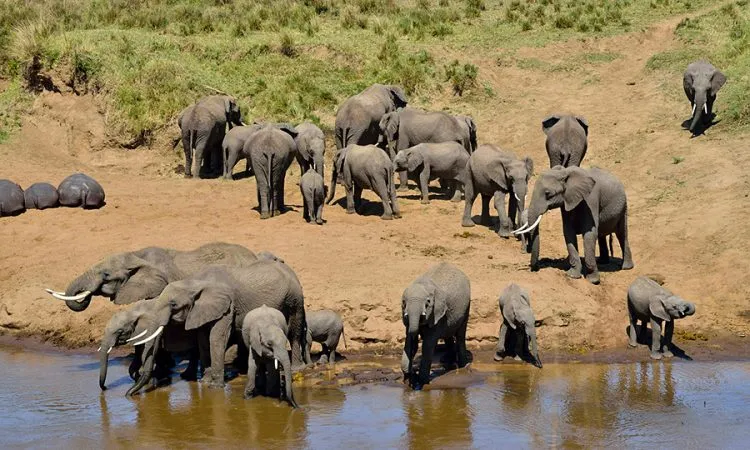
Tarangire has the highest elephant concentration in Tanzania's northern circuit outside of peak Serengeti seasons. During the dry season (July–October), when water sources outside the park dry up, elephants from across the Tarangire-Manyara ecosystem converge on the Tarangire River. Herds of 50–200 individuals moving through the riverine woodland are not unusual. The elephant population within the park's ecosystem is estimated at 2,500–3,000 individuals.
What's distinctive about Tarangire's elephants is their familiarity with vehicles — they've been studied and photographed for decades and generally pay little attention to safari vehicles, allowing close approaches and extended observation. Watching a large matriarchal herd cross the road in front of your Land Cruiser, completely unbothered by your presence, is a different experience from the more cautious elephant behavior in some other parks.
The Baobab Landscape
Tarangire's baobab trees are among the most photographed landscapes in Tanzania — and for good reason. Ancient baobabs (some estimated at 2,000+ years old) dot the golden grass of the open savanna, creating a silhouette that is unlike anywhere else on the northern circuit. The best light is in the early morning and late afternoon when the low sun catches the textured bark and the grass glows orange. Photographers specifically route through Tarangire for these conditions.
The baobab landscape is most striking in the dry season when the grass is shorter and the trees stand out more clearly. In the wet season, the landscape is greener but the baobabs are less dramatic against a uniformly lush background.
Wildlife Beyond Elephants
Tarangire's wildlife diversity is high, though predator sightings are less frequent than in the Serengeti. What you will reliably see:
- Elephants — in numbers, especially at the river and the seasonal swamps in the south
- Buffalo — large herds in the riverine areas and open grassland
- Giraffe — Masai giraffe are common throughout the park
- Zebra and wildebeest — present year-round but in much larger numbers than usual in August–October as the migration circuit brings animals in from outside the park
- Impala, hartebeest, oryx, eland — antelope diversity is exceptional in Tarangire
- Lion — present but less reliably sighted than in the Serengeti; look in the kopjes and along the river
- Leopard — in the riverine forest and rocky outcrops; rarely seen
- African wild dog — Tarangire is one of the best places in Tanzania to see wild dogs; ask your guide for recent sighting locations
- Python — large rock pythons are regularly seen in Tarangire, particularly near the river
Birdlife
Tarangire is exceptional for birdwatching — over 550 species have been recorded. Yellow-collared lovebirds, ashy starlings (endemic to Tanzania), rufous-tailed weavers, and the extremely rare ashy flycatcher are among the highlights. The swamps in the south of the park attract large concentrations of waterbirds during the wet season. If birdwatching is a priority, Tarangire ranks alongside Lake Manyara as one of the best birding sites in the northern circuit.
When to Visit
Tarangire is good year-round but the dry season offers the most dramatic game viewing:
- July to October — peak season. The Tarangire River is the only water for a wide area, concentrating animals in extraordinary numbers. Best elephant sightings. Shorter grass makes for clearer visibility. Roads are dry and accessible throughout the park.
- January to February — short dry season. Good game viewing, fewer tourists. Some areas in the south of the park (Silale Swamp area) become accessible and offer excellent birding and elephant sightings.
- November to December — short rains. Park is green, baby animals are common (wildebeest and zebra calving), fewer tourists. Some roads in the southern circuit can be muddy.
- March to May — long rains. Some areas inaccessible. Wildlife disperses as water becomes available across the landscape. Not recommended for a first visit.
Tarangire Circuit: Northern vs Southern
Most day-trip or overnight visitors explore the northern part of Tarangire, which is the most accessible and where the river-concentrated wildlife is most reliable. The southern circuit — Silale Swamp, Lemiyon area — requires more time (minimum two nights in the park) and 4x4 vehicles with high clearance, but delivers genuinely remote game drives with almost no other vehicles. If you have three or four nights in Tarangire specifically, the southern circuit is worth the logistics.
How to Include Tarangire in Your Safari
Tarangire integrates naturally into any northern Tanzania safari itinerary:
- From Arusha/Kilimanjaro: enter Tarangire on Day 1, overnight at camp inside the park, continue to Serengeti on Day 2 via Karatu
- As the final stop: depart Serengeti/Ngorongoro, descend to Tarangire for an afternoon game drive, overnight, and drive back to Arusha/KIA the following morning
- As a standalone day trip: possible but doesn't do Tarangire justice — a full day departs Arusha by 6am and returns by 7pm
We include Tarangire in our 5-Day Northern Circuit Safari and several other itineraries. See our Tanzania safari packages for full options.
Include Tarangire in Your Safari
Our Moshi team builds custom itineraries combining Tarangire with the Serengeti, Ngorongoro, and Zanzibar. We respond within 2 hours.