
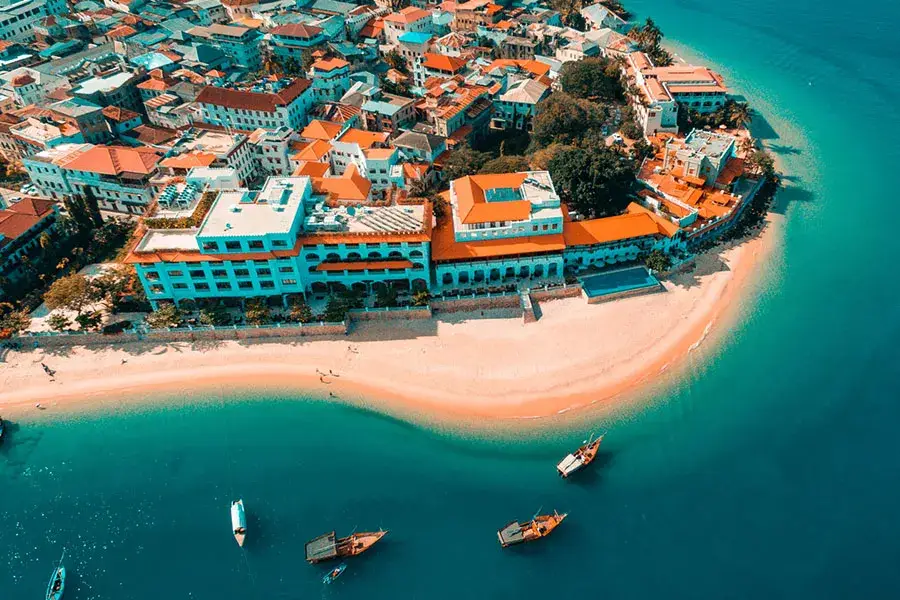
Swahili Civilisation Origins
The word "Swahili" derives from the Arabic word sawahil — "coasts." Swahili civilisation emerged along the East African coast between the 8th and 10th centuries AD through the interaction of Bantu-speaking African communities with Arab, Persian, and later Indian Ocean traders who used the monsoon winds to navigate between the Arabian Peninsula, India, and Africa.
Zanzibar's natural harbour, strategic location, and fresh water made it a critical stopping point on the Indian Ocean trade circuit. By the 12th century, Zanzibar was a well-established trading port dealing in gold, ivory, tortoiseshell, ambergris, and enslaved people sourced from the East African interior.
The Omani Sultanate
In 1840, Sultan Seyyid Said of Oman relocated the Omani capital from Muscat to Zanzibar City — a decision that reflected the island's wealth and strategic value. The Sultanate period (1840–1890) was the peak of Zanzibar's political and economic power. The Sultan controlled the East African coast from Somalia to Mozambique, monopolised the ivory and slave trade, and transformed Stone Town into a city of Arab palaces, mosques, and the elaborate carved wooden doors that remain the most visible architectural feature of the old city.
The spice trade also reached its peak during this period — specifically cloves, introduced to Zanzibar from the Moluccas in the 1820s at the Sultan's initiative. By the 1870s, Zanzibar supplied three-quarters of the world's clove production.
The Slave Trade
The slave trade was central to Zanzibar's 19th-century economy. The central slave market in Stone Town was the largest in the Indian Ocean — an estimated 50,000 enslaved people passed through annually at its peak, sourced from the East African interior (present-day Tanzania, DRC, and Mozambique) and sold to buyers across the Arabian Peninsula, Persia, and India.
Britain pressured Sultan Barghash to abolish the trade in 1873 — the same year the Anglican Cathedral was built on the site of the former slave market. The underground holding cells (maashimo) beneath the cathedral are still visible and form the most significant historical site on Zanzibar. A guided visit to the cathedral and market site is the most important cultural stop in Stone Town.
Architecture and Material Culture
Stone Town's architecture is the most visible expression of Zanzibar's multi-cultural heritage. Three building traditions exist in the old city:
| Style | Characteristics | Where Found |
|---|---|---|
| Arab-Omani | Flat roofs, inner courtyards, Islamic geometric ornament, mashrabiya (lattice screens) | Older mansions, Sultan's palace complex |
| Indian | Overhanging balconies, elaborate woodwork, Indian shophouse layout | Merchant areas, commercial streets |
| Swahili synthesis | Combination of both with African material traditions | Most of Stone Town's residential fabric |
| Colonial British | 19th-century colonial buildings, European scale | Beit el Ajaib (House of Wonders), government buildings |
The carved wooden doors are the single most distinctive architectural element of Stone Town — over 500 survive. Arab doors (pointed arch at top) indicate a Muslim household. Indian doors (flat arch with brass studs) indicate an Indian merchant family. The size and elaborateness of the door signals the wealth of the owner.
Swahili Culture Today
Contemporary Zanzibar is predominantly Muslim (approximately 99% of the island's population identifies as Muslim) with the Sunni tradition dominant. Islamic practices — prayer five times daily, Friday congregational prayers, fasting during Ramadan, modest dress expectations — shape daily life in Stone Town and rural communities. Tourist areas and beach resorts operate with more flexibility, but the cultural context remains.
The Swahili language (Kiswahili) is the national language of Tanzania and serves as the lingua franca of East Africa. Zanzibar dialect (Kiunguja) is considered the most prestigious form of Swahili and is the basis for standard written Swahili. Learning a few phrases is appreciated — jambo (hello), asante (thank you), karibu (welcome).
FAQ
Stone Town cultural visits are included in Day 11 of our 13-Day Tanzania Adventure. Free quote from our Moshi team.